
HEA
Making a complex audio partnership easier to understand and easier to begin
View Project
View Project
Product Design Lead
HARMAN Embedded Audio helps other companies bring audio and voice experiences into their products. Its offer combines technical expertise with the value of recognizable audio brands. But that breadth creates a difficult question for a prospective partner: what exactly would we build together?
I led a redesign that made those relationships clearer, from capabilities and branded-audio programs to real partner products and a qualified first conversation. Working with the executive sponsor, sales lead and development lead, I connected the commercial direction to the information architecture, detailed interface and handoff behind the inquiry.

Results at a Glance

The Challenge: Less Contact Forms, More Credible Opportunities
The executive brief centered on conversion and business growth. I began by aligning the team on what the site could meaningfully improve: helping relevant companies understand HEA’s offer, prepare a useful inquiry and reach the right person.
Sales and I defined the difference between a submitted form, an actionable inquiry and an opportunity worth pursuing. We kept early-stage companies in the journey while separating genuine product-development needs from consumer support, unrelated requests and duplicate submissions. That gave us a commercial measure without asking the website to promise a deal before technical and business review.

The Same Partnership Had to Make Sense to Different Decision-Makers
The engineer needed to understand integration and physical constraints. The product lead needed confidence in development scope and timing. The brand lead needed to understand the customer-facing value of a "Sound by" program. The commercial lead needed a credible engagement and clear next steps.
In this scenario, I combined buyer conversations with a review of sales inquiries and the questions technical teams repeatedly answered. Instead of organizing the site around internal departments, I mapped the decisions each role needed to make and the evidence that could help them move forward together.

Make the Brands More Visible Without Making the Business Harder to Understand
The executive team wanted to give Harman's connected brands a larger role in the experience. I agreed with the opportunity: recognizable audio brands could help prospective partners see the commercial potential. But visibility alone would not explain the relationship.
An ingredient brand, an enabling technology and an external partner were not the same kind of thing. If we gave them the same treatment under a broad “ecosystem” label, buyers could recognize every logo and still misunderstand who made the product, what HEA provided or who they should contact.
I reframed the request around a clearer outcome: visitors should be able to explain the partnership in their own words. That let us expand the brand story while protecting the clarity of the business offer.

Explain What Each Name Contributes, Not Just Where it Belongs
I established a consistent relationship model across the experience. Harman's ingredient brands explained a potential collaboration. Technology pages explained the capabilities behind an integration. Partner stories showed how that contribution appeared in a specific finished product.
The interface made the distinction visible in the content itself. A proof card identified the product company, named the product and explained the audio contribution. Brand-program pages connected to relevant examples without implying those companies belonged to HARMAN. Visitors could explore a program without being required to choose one before describing their project.
I brought the model into reviews with sales, engineering and brand stakeholders. The question was no longer which logo should be largest. It was whether a buyer could understand the opportunity accurately and take a useful next step.

A Cleaner Layout Still Left the Wrong Impression
In the illustrative first test, grouping logos into separate sections improved scanning but did not fully explain the business. Some participants still treated the Sound by names as product manufacturers or assumed a partner company belonged to Harman. The design looked organized; the underlying model was still unclear.
I changed the test from finding a logo to explaining a relationship and choosing a next step. We revised the headings, added explicit contribution labels and connected each program to a real product example. We also replaced a required brand selector with an optional expression of interest, so the interface did not ask buyers to resolve a commercial decision too early.
The next round gave us stronger evidence of understanding. More importantly, it changed our acceptance criteria: the experience had to communicate the relationship correctly, not merely make the brands easy to find.

Let People Start With the Question They Already Have
I designed three connected entry points: explore technical capabilities, understand branded-audio opportunities, or examine a relevant partner product. Each supported a different starting question while converging on a shared evaluation and inquiry.
The structure preserved direct access for engineers and made the commercial story accessible to product and brand leaders. A partner story became useful evidence within the journey, rather than a logo gallery disconnected from the service it demonstrated.

Help Buyers Prepare for Engineering Review Without Pretending to Replace It
A recognizable brand could establish interest, but it could not settle acoustic fit. I worked with the technical lead to make the questions behind an integration understandable: the product format, listening environment, physical space, power constraints and intended experience.
We put useful guidance ahead of contact and allowed buyers to leave unknowns open. I deliberately deferred an automatic brand or technology recommendation. A structured project summary was a more credible first step than an interface that appeared to certify a product from a few answers.

Ask Enough to Start Well, Without Asking Buyers to Solve the Project First
Sales needed context. The executive sponsor wanted a more approachable path to contact. Development needed a flow it could maintain. I used a progressive inquiry to separate essential contact information from project context and optional detail.
Buyers could identify the product they were developing, explain what they wanted to improve and indicate a development stage. Brand interest was optional and supported “Help me explore.” The review screen showed what would be shared and explained the next step without implying acceptance into a program.

Reducing Form Effort Only Helped if it Reduced Effort for the Whole Journey
In the pilot, the shortest inquiry produced more submissions but left sales repeating basic questions. Buyers had completed the digital step, yet their project still lacked enough context for a useful response.
I reviewed the handoff with sales and separated information needed for routing from information that could wait. We kept application and stage, preserved the originating capability or program, and made uncertainty explicit. The next iteration was evaluated on actionable requests and clarification effort as well as completion.
Preserve the Project, Not Just the Contact Details
I worked with the development lead and sales lead to define what happened after submission. The request preserved the context the buyer had reviewed, including its source, technical interests and any brand-program interest. A received inquiry remained distinct from technical feasibility, brand approval and an opportunity accepted by sales.
We planned for delayed integrations and unmatched routing. A saved request could be retried into the receiving system without asking the visitor to submit again. Requests needing both engineering and brand review retained a single accountable contact, preventing the buyer from becoming the coordinator between teams.

Make Clarity a Rule the Next Page Cannot Accidentally Break
I stayed hands-on with the typography, spacing, responsive layouts and interaction states. But the most important reusable component was the relationship between a program, a partner and a product.
With engineering and content owners, I translated that relationship into a publishing model. A partner-proof module required a product company and a scoped contribution. A program page required an approved identity and owner. Review dates and source records made claims easier to maintain. This let teams expand the site without recreating the original ambiguity.

Align the Team Around Decisions People Could Evaluate
I owned the experience direction and the detailed design. The executive sponsor set the commercial ambition and resolved scope. Sales owned qualification and follow-up. The development lead owned implementation. Brand and technical reviewers approved the claims within their areas.
I used prototypes and decision records to connect each recommendation to the buyer problem, business effect and delivery cost. When the brand expansion request risked becoming a larger gallery, I made an alternative concrete: more explanation, stronger product proof and a clearer route into the business. That gave the team a way to support the objective without accepting the ambiguity.

Measure Understanding Before Celebrating Conversion
We defined success at three levels: whether buyers understood the offer, whether the handoff gave the team useful context, and whether more relevant inquiries progressed into opportunities. Each level required different evidence.
Before launch, I paired comprehension testing with end-to-end inquiry checks. After release, the proposed reporting connected site activity to sales disposition, using consistent definitions and equivalent follow-up windows. We examined acquisition source, region, returning buyers and trade-show activity so a campaign spike would not become a redesign claim.
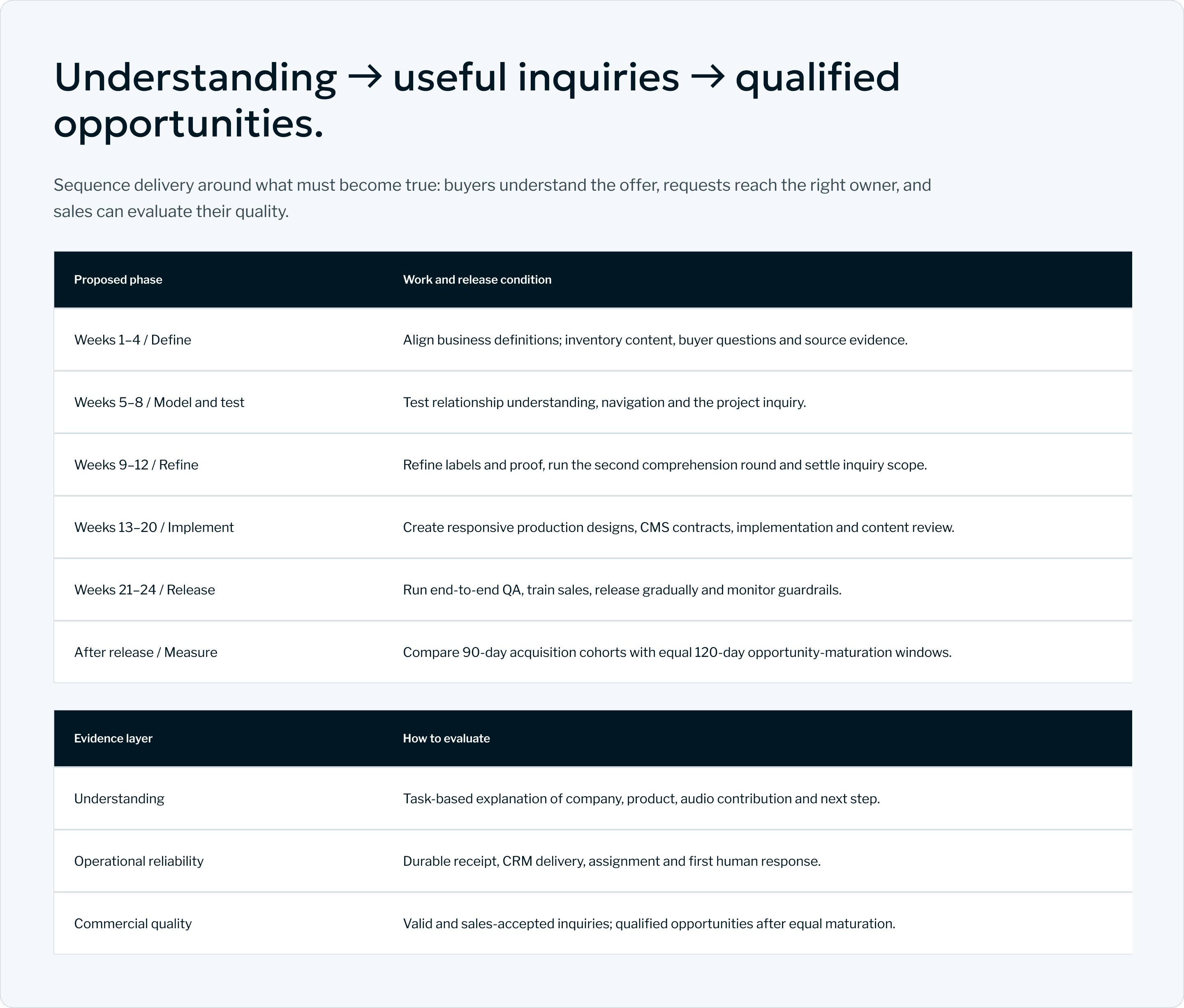
The Outcome: Better Understanding Created a Stronger Starting Point for the Business
In this best-case scenario, buyers became better able to explain HEA’s role and begin a relevant conversation. Sales received more actionable project context, and the business progressed more inquiries into qualified opportunities.
The result was a coherent path from brand recognition to technical and commercial evaluation. The evidence would support better understanding and a more useful handoff. It would not establish that the website alone closed more deals or that one component caused the full improvement.


