Ticketmaster
Growing offer engagement while protecting ticket conversion.
Product Designer · Sole designer on team of 4 engineers
I led UX research, experimentation, and product design for personalized offers within Ticketmaster’s purchase journey. By aligning offers with customer intent, we increased active offer engagement from 0.5% to over 4.5% while maintaining ticket-purchase conversion.


The Challenge: Create Revenue Without Compromising the Purchase
The disruption of live entertainment during COVID-19 put Ticketmaster under significant financial pressure. As part of its company-wide Cost Reduction Program, Ticketmaster engaged our team to develop additional revenue opportunities within its digital experience.
Our mandate was to introduce relevant advertising and offers while protecting ticket-purchase conversion.
That created a clear tension. Customers came to Ticketmaster to secure tickets, often with a specific event in mind and limited time to complete their purchase. Additional offers could create commercial value, but they could also distract customers at a consequential moment.
Success required understanding where an offer could earn its place in the experience.
My Role: Connecting Research, Design, and Experimentation
As the team’s sole designer, I led research structuring, experimentation, and design implementation. I owned offer placement and format, the information architecture exposing offers throughout the journey, and the behavioral criteria informing which offers customers should see.
I partnered with data science and engineering to translate predictive signals into experience decisions. Ticketmaster’s design and sales teams were our primary stakeholders, collaborating with our engineers to bring research and iterations into production.
I directed day to day design decisions, with weekly reviews providing oversight from my design manager.

Starting With the Customer’s Immediate Goal
During the first month, we combined behavioral observation and analytics with customer surveys distributed by Ticketmaster. We used live experimentation and holdout traffic to test our hypotheses while monitoring the core purchase experience.
The research pointed to a highly goal directed journey: customers were often emotionally invested in an event and focused on completing a specific purchase.
Their response to advertising depended on what it offered and when it appeared. Irrelevant promotions were unwelcome; offers connected to an immediate need could attract meaningful engagement.
This became our working hypothesis:
An offer could add value when its relevance and timing matched the customer’s current task.
We tested that hypothesis against purchase conversion, abandonment, engagement, and customer sentiment.

Design Around Moments of Relevance
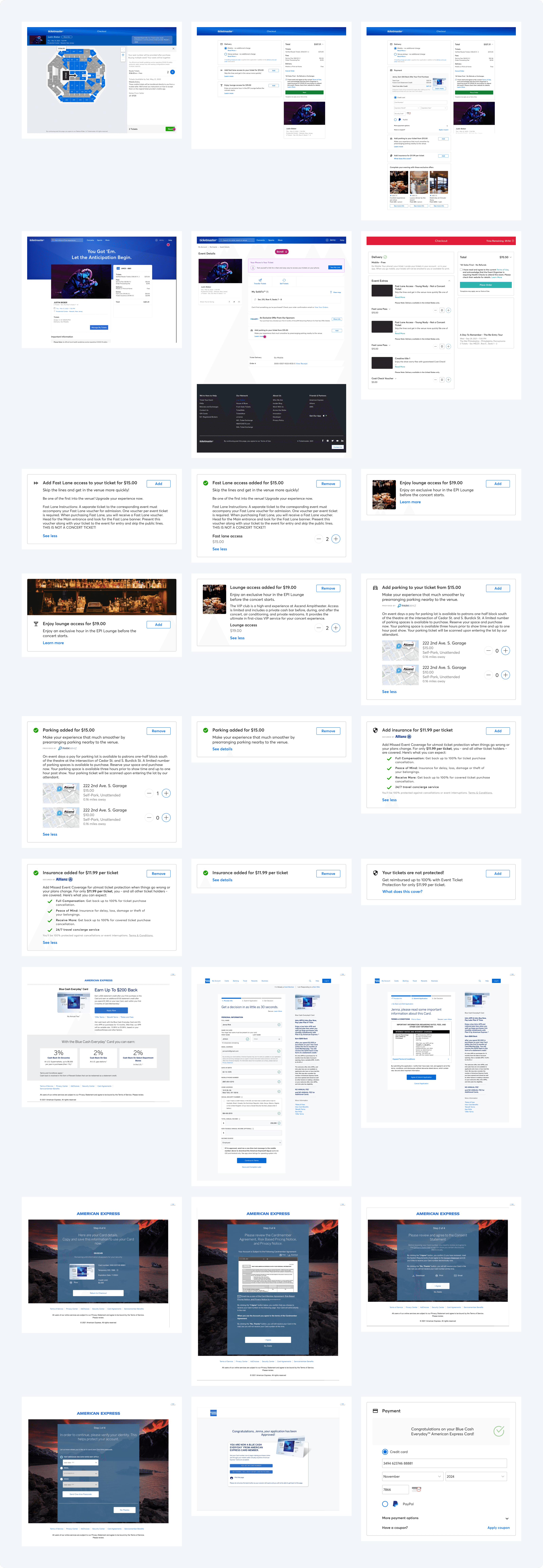
I translated the research into an information architecture that connected offer categories with customer needs. The experience brought together financial incentives, event logistics, protection, and nearby activities.
Introduce Value Where Customers Consider How to Pay
Credit card offers appeared within the payment experience, connecting the promotion to a decision customers were already making.
I defined the placement and format of the offer, including the hierarchy between the value proposition, supporting information, and action. The intent was to make the offer understandable within the payment context while preserving the ticket purchase task.

Connect an Add-On to the Practicalities of Attending
Pre purchased parking addressed a concrete need associated with the event: getting to the venue. Additional arrival based add-ons including fast lane access and seat upgrades were also included.
The module exposed the starting price and an optional add action, with supporting information available for customers who wanted to learn more. This positioned arrival add-ons as a relevant part of planning attendance.

Make Protection a Distinct Decision
Ticket insurance appeared as a separate optional offer with per ticket pricing and access to coverage information.
The information hierarchy gave customers a way to evaluate the proposition before deciding whether to add it.

Expand From Buying Tickets to Planning the Occasion
Additional offers introduced experiences in and around the venue. The supplied design includes nearby dining, pre show cocktails, and accommodation.
Grouping these opportunities into a dedicated discovery module helped customers understand their relationship to the event and compare options through price, imagery, and supporting details.

Customers Needed More Than One Offer and More Detail to Decide
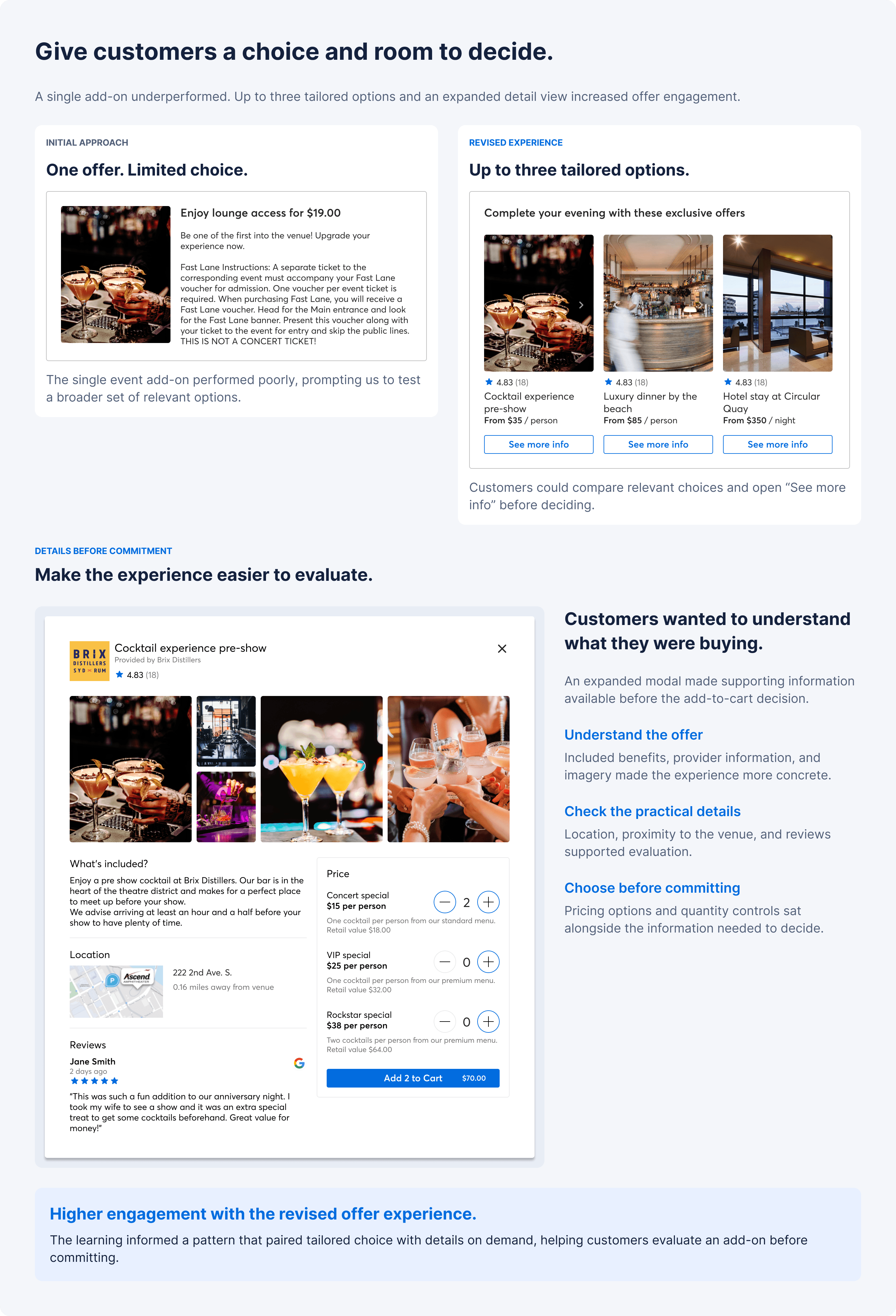
An early version presented a single event add-on. It performed poorly, prompting us to reconsider both the range of options and how customers could evaluate them.
I redesigned the module to present up to three tailored add-ons, giving customers relevant alternatives to compare. Each option included a “See more info” action that opened an expanded modal with imagery, what was included, location, reviews, and pricing options before the add-to-cart decision.
The revised experience produced a substantial increase in offer engagement. Our testing also showed that access to more detail was an important part of the improvement: customers wanted to understand the experience they were purchasing before deciding.
This changed the design principle behind the module. Relevance helped an offer earn attention; choice and accessible detail helped customers evaluate whether it belonged in their evening.
Personalization Included Deciding What to Exclude
Placement alone could not make an offer relevant. I also defined exclusion criteria based on prior exposure, responses to similar offers, and inferred account behavior.
Working with data science and engineering, I helped translate these inputs into decisions about which propositions to surface or suppress.
Account linked purchase patterns could suggest an affinity for a category or brand. Previous interactions could indicate whether a similar offer was likely to be useful. Prior exposure could inform whether an offer should appear again.
These signals were predictions to evaluate through customer behavior. They gave us a way to adapt the experience beyond showing the same promotion to every customer.